Skip to content

What a Billion-Dollar Book Taught Me

Running a billion-dollar book teaches you less than you expect — and what it teaches is simpler than the industry will ever admit.

Field note · 17 December 2025 · 5 min read

The first person I watched blow up a position had done the work correctly.

The analysis was sound. The company was genuinely undervalued. The thesis held — and the market moved against it anyway, for nine months longer than anyone had modelled, until the trader who'd built the position ran out of runway and cut it. Two months later the stock did exactly what he'd said it would.

He was right. He just wasn't there to see it.

The lesson a billion-dollar book teaches you isn't about finding better ideas. It's about surviving long enough for the ideas you already have to play out.

The bet size is the whole strategy

Position sizing — how much you actually put on any given idea — matters more than what you're betting on.

Most people, when they think about investment risk, think about probability: will this go up or down? Am I reading this correctly? After a decade, I came to think about risk differently: as the magnitude of what happens when you're wrong, multiplied by how much you had on it.

Sized too large, a 15% drawdown can become existential — a liquidation forced by margin, by a client redemption, by the fact that you simply can't hold it emotionally. Sized correctly, a 30% drawdown is painful but survivable, and survivable means the thesis gets the time it needs.

A great trade, sized too large, can end you. A mediocre trade, sized sensibly, costs you a little.

I watched this pattern repeat across ten years. Brilliant people with correct analyses and ruinous outcomes — not because their thesis was wrong, but because their conviction in it led them to put on a size they couldn't survive being wrong about. The market moved against them, temporarily. They couldn't stay solvent through the temporary part.

The question isn't "do I believe in this?" It's "if I'm completely wrong, can I absorb it and stay in the game?"

Behaviour moves markets; models explain them after

What moves prices over short periods is behaviour — fear, greed, momentum, crowd panic at a press conference — rather than any fresh read of fundamental value.

In a well-diversified portfolio, fundamentals tend to reassert over full cycles — but any single position can defy that long enough to end the trade. "Over time" can mean years: long enough to end careers and blow up portfolios before the thesis is vindicated.

Morgan Housel put it plainly in The Psychology of Money: the gap between what makes logical sense and what humans actually do with money is enormous. Markets aren't a maths problem. They're a behaviour problem. I watched PhD mathematicians lose money because they couldn't emotionally tolerate a drawdown their own model said was temporary. I watched traders with no formal training make consistent money because they were willing to sit still.

A Black man in a long wool overcoat, back to the viewer, seated alone on a commuter platform bench as a packed train blurs past — a folded newspaper resting on his knee, the platform otherwise swept empty by the rush.
Sitting still while everyone else boards is an active decision. Most people can't make it.
Patience and temperament are the edge. You can't outsource them.

The desk with the most data didn't win

The traders who performed consistently well over time used less information than you'd expect.

A serious trading operation has a dozen data feeds running simultaneously and thousands of functions on the terminal. The amount of information available at any given moment is staggering. Past a certain point, more of it doesn't improve decisions — it creates more noise to filter, more false signals to resist, more occasions to act when waiting was the right call.

A Black man in a worn canvas jacket, face turned toward old brass scales at a market stall, one pan holding a small iron weight and the other a single faintly glowing coin — the beam resting in perfect balance.
The whole discipline is learning what to weigh, not how much to carry.

Complexity in strategy correlates with fragility. The thing that works across most market environments tends to be simpler than the thing optimised for one environment and catastrophically wrong in another.

This is what I think about when I look at a plain, diversified, low-cost portfolio held patiently for decades. It doesn't look like it's doing anything impressive. That's the point.

What I carried out — and what it cost

I left the trading floor with three clean things: a visceral respect for position sizing; the discipline to be boring; and the certain knowledge that this was always simpler than the industry needed it to appear.

The complexity was load-bearing. It held up the fee structures, the advisory relationships, the whole apparatus. Once you see it clearly, you can't fit the pieces back together.

In 2015 I broke my own first rule. I put too much of my own money into a single position I was certain about — no serious plan for what I'd do if it went against me. It went against me. I knew everything I'd spent a decade learning. I suspended all of it because I was confident. That's precisely when confidence is most dangerous.

The trader I watched at the start of my career? He was right about the company. He was wrong about how much time he had.

That's the whole lesson. It always was.

All essays

The independent AI studio of Sean Melis · London

Build what you’ve been putting off.

Solve a problem that keeps coming back. Learn to build with AI. Or start with a course, app or tool I have already made.

Why this matters

AI can help you do more. You still decide what is good.

AI can handle work that repeats and help turn an idea into a first version. You decide what matters. I help you build it.

Click or press Enter to play or pause. Press Escape to close the theatre. 02:25 · stills, music and captions
Meet Sean · London

Ten years of using AI to solve real problems.

I’m Sean Melis. I use AI to solve problems in my own work and with clients. When something works, I turn it into a course, app or tool you can use too.

A tactile Polaroid of Sean Melis drinking a beer, captioned ‘the internet can feel different’
Proof of the work

Ten years of building and teaching.

30,000+Students taught
50+Projects, startup to enterprise
2017–2023Co-founded an AI agency and startup
10+Industries, sport to beauty to banking
Automation consultingat Deloitte
AI agent innovationat PA Consulting
“Captured our brand personality perfectly—professional, authentic, and playful.”Tahlia Sher · L’Oréal (CeraVe)
Selected clients
Find what you need

Choose where to start.

Start with what you want to learn, fix or make.

Arrival Choose one problem, one goal and one dream. 01 / The Arrivals Hall

New here? Start here.

AI Magic 2033

The Art of Living with Superintelligence

Seven acts and 44 chapters on using AI while keeping your judgement, taste and control.

  • Bring one problem, one goal and one dream
  • See Sean build with real working files
  • Make one useful first version
  • Keep the course tools in your Studio
The foundation course · $197 · Coming soon
Is this you?

For people with an idea to build or a problem to solve.

You do not need to be technical. You do need to stay curious, make decisions and care about the result.

This is for youif…

  • you have an idea but no technical team
  • the same task steals time every week
  • you want help without losing your voice or choices

It may not be for youif…

  • you want guaranteed money or instant success
  • you want AI to make every decision for you
  • you want AI to produce lots of work, rather than help you finish something useful
And one more thing

You don’t have to buy anything. You still get this.

An account costs nothing, and there is no trial to cancel. It opens a room of tools, libraries and small apps you can start using today.

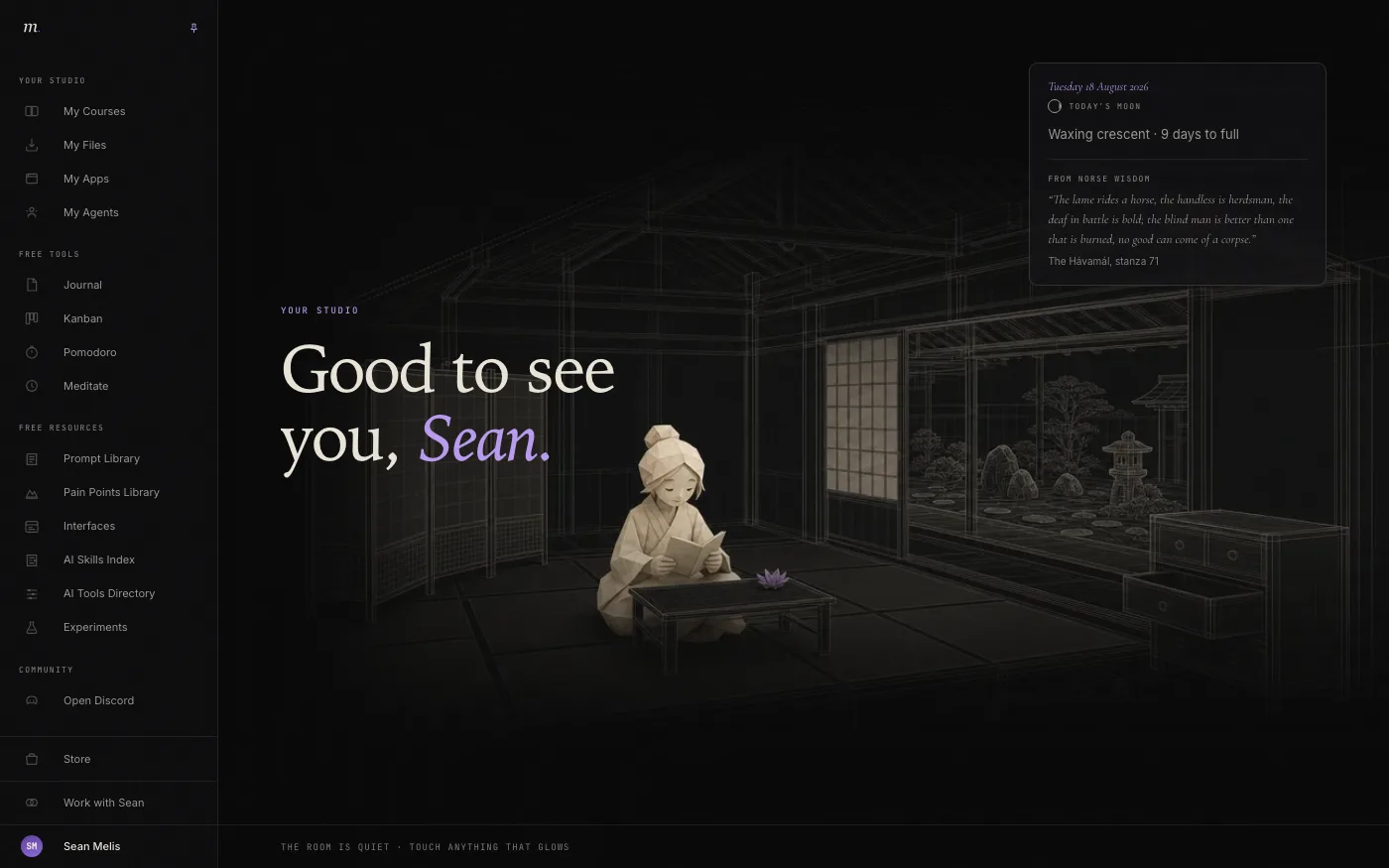
Your Studio · live product preview
A look inside the StudioStudio preview
Your Studio
The Studio open on a desktop, showing the room and its side rail.
The same Studio on a phone.
A look inside the StudioWider on a desktop
Inside the Studio

Join once. Get all of this free.

The shop is where you find things. Your Studio is where they live. Anything you buy lands there too, everything runs in your browser, and your work stays private.

  • 365 promptsPrompt Library
  • 50 pain pointsProblems worth solving
  • 50 AI skillsSkills Index
  • 50 AI toolsTools Directory
  • ExperimentsBrowser-only tools
  • Private journalThink things through
  • Simple KanbanTo Do, Doing, Done
  • Focus timerPomodoro
  • Meditation timerA quiet pause
  • Interface galleryUseful patterns
No card required
Loading available times…
Custom work · By application

What do you want to build?

Tell me what you want built. I read every one, and reply if it’s a fit.

Aetherboard

One infinite whiteboard that lives on your Mac.

Try Aetherboard ↗ $99$49 onceFounding Owner

$99 after the first 100. Yours permanently, with 12 months of updates.

Mac, offline. You get the files and readable source.

Founding price$49 once
OwnershipFiles + readable source
Works onMac · offline
Standard price$99 after 100
The Aetherboard canvas: handwritten headings, sticky notes, pinned pictures and the tool bar along the bottom $99$49 onceFounding Owner
A calm paper-crafted workspace inside Aetherboard

Stop renting your thoughts. Own the board.

Try the real canvas in your browser. The first 100 owners pay $49 once, keep the Mac app permanently and receive 12 months of updates. The standard price is $99.

Pages, products and essays↑↓ move↵ openesc close