Ancient Wisdom Is Diagnostic
The old texts aren't decorative quotes for a wall. Used properly, they're a diagnostic tool for the crossroads you're standing at.
Guide · 18 February 2026 · 7 min read
She arrived with three books in her bag and the same question she'd been carrying for six months.
They were good books — Seneca, the Tao Te Ching, a well-worn copy of The Alchemist. She'd marked passages in each one. She could quote Seneca on adversity. She knew the lines about the obstacle being the way. What she couldn't explain was why she kept waking at half past four with the feeling she'd made a wrong turn somewhere, years back, and couldn't locate exactly when.
I work in Delphi now. The inscription — γνῶθι σεαυτόν, know thyself — is carved in stone near the sanctuary entrance, a few minutes' walk from my door. I have walked past it more mornings than I can count. And in twenty years of sitting with people at crossroads, I have noticed something consistent: the people who have read the most wisdom are not always the people who know themselves best. Sometimes they know the texts so well that the texts have become a kind of shelter.
You can stand inside a beautiful sentence and still be completely lost.
Ancient wisdom was not written for shelters. Most of it was written for people in specific, difficult straits — people who had lost power or were losing it; people who needed to think clearly about something pressing with real force. The Enchiridion was Arrian's compilation of Epictetus's lectures, assembled as a pocket manual for conditions the philosopher could not control — he had been enslaved. Marcus Aurelius wrote his Meditations to himself, as a private accounting nobody was meant to see. Heraclitus wrote in fragments so compressed they were designed to be worked with, not placed above a desk.
Used as decoration, these texts let you feel you've engaged with a hard idea while doing nothing with it. Used as a lens — held up to your specific circumstances, not wisdom in general — they help you see something you couldn't quite bring into focus on your own.
The difference is not how carefully you read. It's what question you bring.
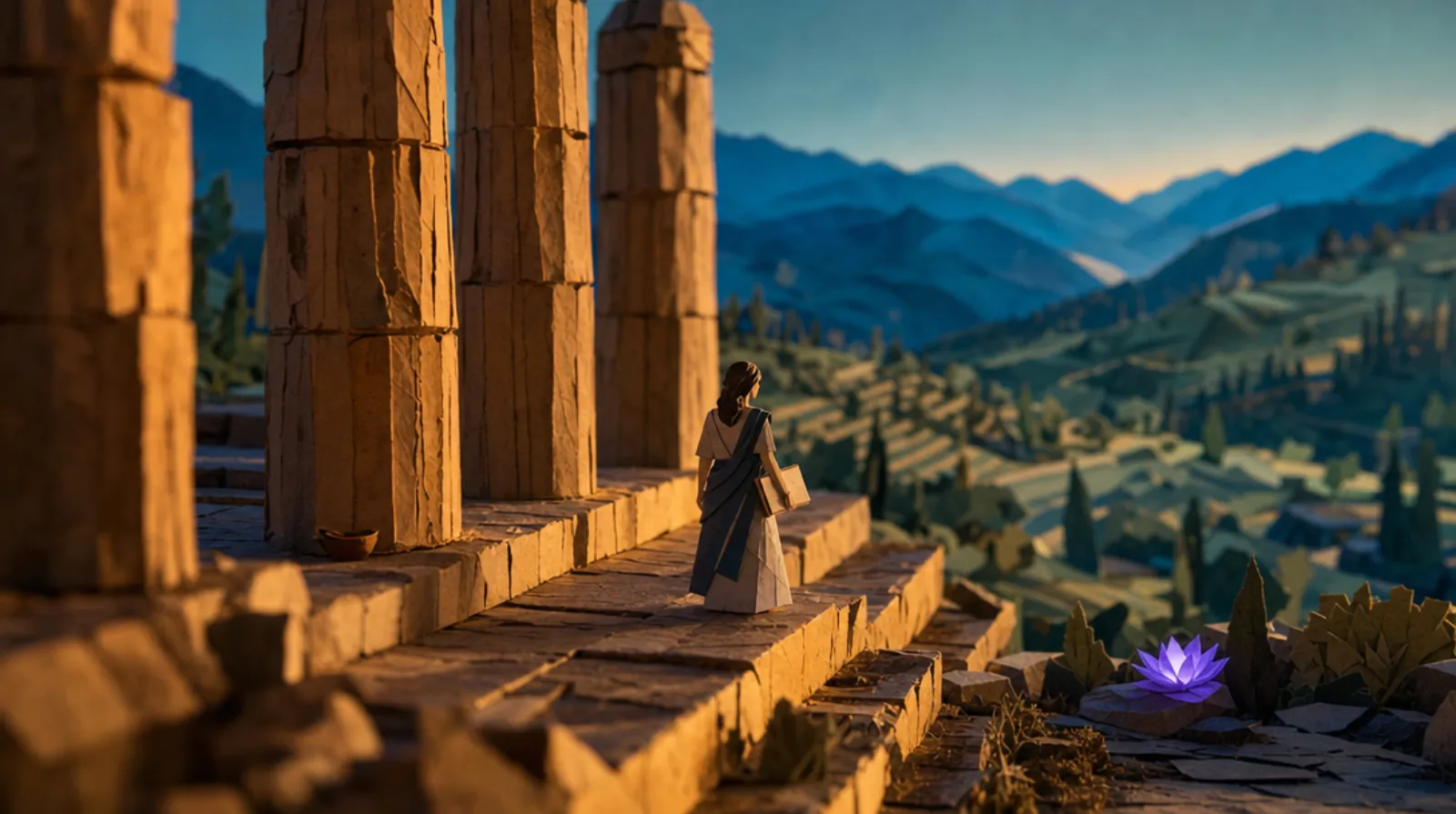
The oracle didn't reassure anyone
A diagnosis is not a comfort. A doctor who diagnoses well tells you something true about what is happening in your body, regardless of whether it is convenient. The value is in the precision: knowing what you're actually dealing with means you can respond to it. If the diagnosis is wrong — or if you use the appointment to collect reassurance rather than information — the problem continues unchanged.
Ancient texts work the same way when you're honest with them. The question that tends to disappoint is: what can I apply to my life? That question produces a layer of good intentions over an unchanged situation. You leave with a quote and nothing shifts.
The question that cuts is different: what is this text actually pointing at — and does it locate something true in my situation right now?
One question lets you stay comfortable. The other one doesn't always.
Three lenses, not three quotes
"Know thyself." The inscription at Delphi — γνῶθι σεαυτόν — was not placed at the sanctuary entrance as inspiration. It was a precondition. The oracle's counsel was only useful to someone who already knew, with some honesty, what they were actually asking. Many who arrived thought they were asking about outcomes — war, an inheritance, a marriage. The inscription demanded a harder question first: do you know what you genuinely want here, separate from what you've inherited, been told to want, or are afraid of losing?
When I sit with someone who has been circling the same decision for years, this is where we usually begin. Not as a quote to admire — as a genuine question to stay inside. Do you know what you want here — not the socially acceptable answer, but the actual one? Very often the honest answer is: not entirely. That honesty, however uncomfortable, is more useful than any plan built on top of its absence.
Heraclitus on what moves and what doesn't. The familiar line — you cannot step into the same river twice — is Plato's paraphrase, not Heraclitus's surviving words. What Heraclitus wrote was: on those who step into the same rivers, ever different waters flow. The decorative reading takes this as reassurance: change is natural, impermanence is fine, carry on. The diagnostic reading asks something harder: what are you trying to preserve that no longer exists? What version of a situation, a relationship, or a self are you insisting the river still carry, when the water moved past years ago?
That single question does more useful work in a conversation than months of advice about "adapting to change." It is not about accepting impermanence in principle — most people already accept it in principle. It's about naming the specific thing you are refusing to let be different.
Epictetus on what is actually yours. The opening of the Enchiridion — some things are in our power, some are not — is so familiar it has lost most of its edge. It tends to arrive as permission to stop worrying about outcomes, which is useful, as far as it goes. The more demanding reading applies it as an inventory, not a reassurance: have you built your sense of yourself, your plans, your daily effort, around things genuinely in your power — or around outcomes, approval, and circumstances entirely outside it?
My mother grew up in Lagos, in a tradition that has a name for what you find at the bottom of that inventory: ori — the inner head, the seat of destiny in Yoruba cosmology, the divine self that already knows what it was made for, before expectation and comparison covered it over. Epictetus arrives at a similar place from a different direction. The inventory is uncomfortable. It's supposed to be. The text doesn't soothe the attachment. It illuminates it, with a precision that's hard to argue with.
The flinch is the finding
On the archery range, I learned something useful about tension. The aim is not to eliminate tension in the bow — it's to hold it fully, without releasing too soon. Let go before the aim is settled and the arrow goes nowhere particular. The tension is the instrument.

Reading an old text diagnostically works something like this. You read a passage not for what it says in general, but for what it says to you, now, about this particular thing. When you reach a line that produces resistance — a slight tightening, a desire to move on, a quick mental yes, but — stop. That is where the diagnostic value tends to live. The flinch is not discomfort to push past. It's a finding.
This is not about reading to be challenged for the sake of it — that becomes its own kind of performance. It's about noticing where the text has more precision than your current self-narrative. The old writers were precise because they were composing under real conditions and real stakes. They could not afford to be vague. That precision is what you're after. It cuts past the story you've been telling yourself, which has had time to get quite polished.
One caution, honestly earned: the texts you find most beautiful are often the ones that already match what you think. They confirm you. The texts that are most useful are usually the ones that say something you didn't quite have language for and are somewhat uncomfortable about. Beauty and usefulness overlap — but not always where you expect.
The same question, six months later
The woman with the three books eventually arrived at an honest answer to the question she'd actually been carrying. It wasn't in any of the passages she'd underlined. It came from sitting inside the original question long enough to stop negotiating with it.
She didn't stop reading Seneca. She reads him differently now.
The stone at the sanctuary entrance is worn smooth by centuries of hands. People have been bringing their hardest questions to it for a very long time. It doesn't answer anything. It just holds the weight of what you bring. That, in the end, is what the old texts do.
You bring your situation. They ask back. What you make of that exchange is still entirely yours.