The 3pm Crash Isn't Normal
Everyone treats the afternoon slump as a fact of life. It isn't — it's a circadian signal you can read, and mostly fix, before you reach for another coffee.
Essay · 24 June 2026 · 6 min read
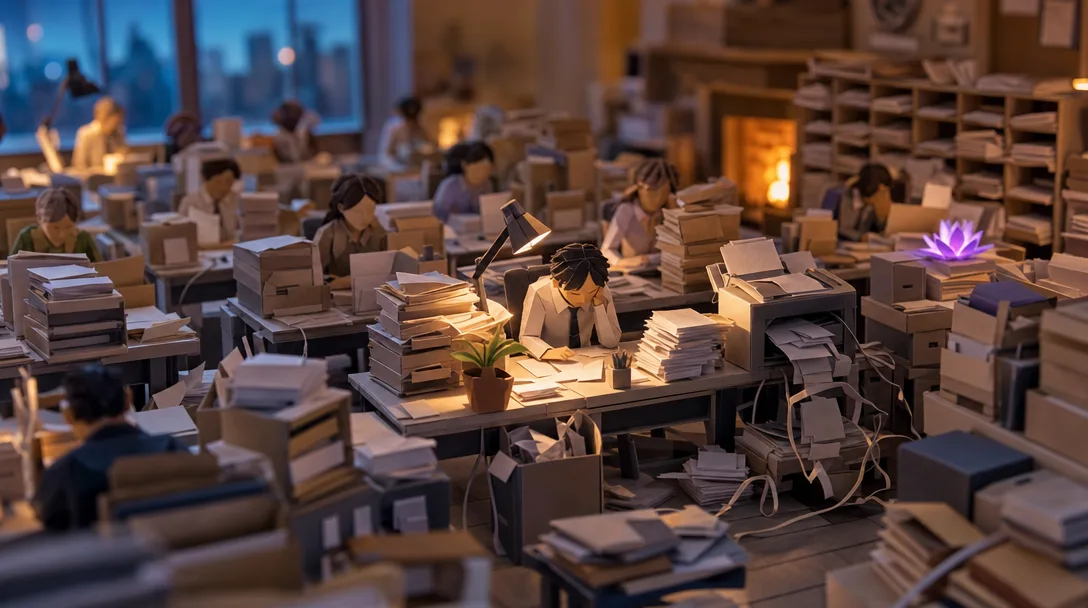
Every afternoon around half past two, the whole ward would start to sag. I'd watch it from the nurses' station — shoulders rounding, a handover trailing off mid-sentence, one more colleague drifting toward the espresso machine like it was magnetic. For years I blamed the cafeteria food. I was wrong. The food had nothing to do with it.
Here's the part nobody mentions: the afternoon crash isn't caused by lunch. It shows up when you skip lunch. It shows up in people who are fasting. That thick, almost irresistible pull toward the desk is your body running a scheduled dip — doing exactly what it was built to do.
It's not a flaw. It's a FEATURE.
We just treat it like a moral failing — white-knuckle through, reach for another coffee, feel vaguely guilty for not holding it together at 3pm like proper adults. Nobody told us the dip was on the timetable from the day we were born.
What's actually happening at 3pm
Your alertness is a tug-of-war, and once a day you lose it on purpose.
Adenosine — the chemical that makes you sleepy — builds in your brain all day, quietly raising the pressure to sleep. Against it, your circadian system fires a steady wake signal that, most of the day, wins. But once every twenty-four hours, usually between 1 and 3pm, that wake signal dips while adenosine keeps climbing. The two collide. You feel it in your eyelids.
Matthew Walker, in Why We Sleep, puts it plainly: humans are biphasic. We're wired for two sleeps — a long one at night and a short one in the afternoon. Siesta cultures didn't invent the nap; they honoured something that was already there. 살림, my halmeoni would have called it — the art of tending to life instead of bullying it. The rest of us — Seoul, New York, London — override the signal and pay for it later.

Seoul makes it worse, structurally. The city is genuinely nocturnal — restaurants full at midnight, convenience stores as 2am social hubs, half the people I know treating 1am as a reasonable bedtime. Staying up late and performing at 9am runs on continuous chemical intervention. The crash here isn't bad luck. It's the bill arriving.
Why yours is worse than it needs to be
The dip is universal. The intensity is not — and the intensity is the part you control.
Sleep six hours instead of eight and you carry yesterday's adenosine into today. The trough and the sleep debt land together, and you don't feel tired — you feel INCAPACITATED. That isn't weakness. It's arithmetic.
Then there's light. Your clock is set, mostly, by bright light in the first hour after waking — 아침해, morning sun on your face. It tells your brain what time it is, which sets when the afternoon trough lands and how hard it hits. Phone-first, dim flat, no daylight until noon, and your clock runs blurry: the crash arrives at the wrong time and hits harder. Evening screens finish the job — blue light past 9pm suppresses melatonin, pushes everything later, and you arrive at 2:30 the next day already behind.
My halmeoni was outside before 7am every day for sixty years — walking to the market, face to the east. She never heard the words "circadian clock." She just lived like one.
The coffee is a loan
The mistake I see more than any other: treating caffeine as a cure when it's only a delay.
Caffeine doesn't remove adenosine — it blocks the receptors, sits in them, and pushes back the reckoning. And it has a half-life of around five hours. That 3pm coffee is still running at half-strength at 9pm.
So you borrow the alertness now and repay it at midnight, with interest — by wrecking the exact sleep that would have fixed tomorrow's crash. The cycle feeds itself: bad sleep, worse crash, more coffee, worse sleep.

So, at 3pm
Stop fighting it. The trough typically runs two to three hours — it passes on its own. What you do inside that window is the whole game.
Nap, if you can. Twenty minutes or less, before 3pm. It's the physiologically correct response — literally what the signal is asking for. NASA studied this in pilots: a short nap improved performance by 34% and alertness by 54%. Sleep medicine has known it for decades; most workplaces still treat rest as a character flaw.
If a nap's impossible, get outside. Ten minutes of real daylight around 2pm — through actual air, not a window — nudges the wake signal back up. Walk while you do it: moderate movement drives a catecholamine surge that temporarily overrides the fatigue signal.
If you genuinely need the caffeine, take it before 1pm. Not at 3.
The 3pm crash is information, not a problem. The foggy meetings, the decisions made between 2 and 4 that looked worse by morning — those aren't random. They're concentrated in the trough, every day, for everyone. Your calendar doesn't know that. Your body has known it the whole time.