Move Like a Korean Grandma
The longest-lived people on earth don't exercise — they just never separated movement from life, and that distinction is quietly everything.
Guide · 4 April 2026 · 7 min read
My halmeoni walked to the market every morning until she was eighty-four. Not for exercise — for the market. She walked there, carried things back, climbed four flights of stairs to her apartment in Mapo-gu, and sometime before noon she'd be on her hands and knees mopping the kitchen floor because, as she put it, the mop doesn't get the corners right.
No gym. No athleisure. She never once announced she was Going For Exercise. When I suggested — somewhere near the end of my doctorate, feeling like I had useful knowledge — that she consider a fitness class, she looked at me the way Korean grandmothers look when you've said something foolish: patient, gentle, completely certain.
She was, at that point, healthier than most of the fifty-year-olds I was seeing in clinic.
That's the thing I couldn't stop thinking about.
Turning movement into "exercise" gave us a reason to skip it
The fitness industry made a quiet category error that cost us more than we realise. It took movement — something that used to be embedded in daily life as ordinary texture — and separated it out, relabeled it EXERCISE, gave it a time slot, a location, and the correct footwear. That formalisation made it easy to skip.
You can't skip going to the market if the market is how you eat. You can skip the gym, every day, with a reasonable excuse. Most of us do.
James Levine at the Mayo Clinic spent years on a deceptively simple question: why do some people stay lean without trying while others gain weight despite controlling their diet? His answer was NEAT — Non-Exercise Activity Thermogenesis. The energy burned through everything that isn't formal exercise: walking, standing, fidgeting, carrying groceries, climbing stairs, cooking, mopping floors.
Levine found NEAT can vary by up to TWO THOUSAND CALORIES a day across the full spectrum of human occupations. Even within ordinary life — the market trip versus the elevator, the floor-mopping versus the Roomba — the gap adds up in ways the gym doesn't replicate. Not from workouts. From ordinary life, lived differently.
My halmeoni didn't exercise. She lived. The distinction sounds like wordplay. It turns out it's almost everything.
The world's longest-lived people don't do burpees
None of the world's longest-lived communities run on gym memberships. Dan Buettner's Blue Zones research — documenting populations in Okinawa, Sardinia, and Nicoya — finds the same structure everywhere: movement embedded in daily life as permanent texture, not scheduled performance. The Okinawan women tend their gardens into their eighties. The Sardinian shepherds walk five miles a day or more because that's where the sheep are, not because they have a step goal.
None of them own a fitness tracker.
Watch an older Korean woman move through her day and you'll notice she barely stops. Not frantically — more like she has a different baseline relationship with stillness. She'll squat to a low shelf and hold the position while she thinks. She'll walk two stops rather than ride the bus because the bus is slow and she'd rather move. She might be at the park at 7am for 아침 체조 (achim chejo — morning calisthenics, done in clusters in any Seoul park before 8am) — not because a doctor recommended it, but because that's what you do before the day starts.
Then she gets on with the actual day.
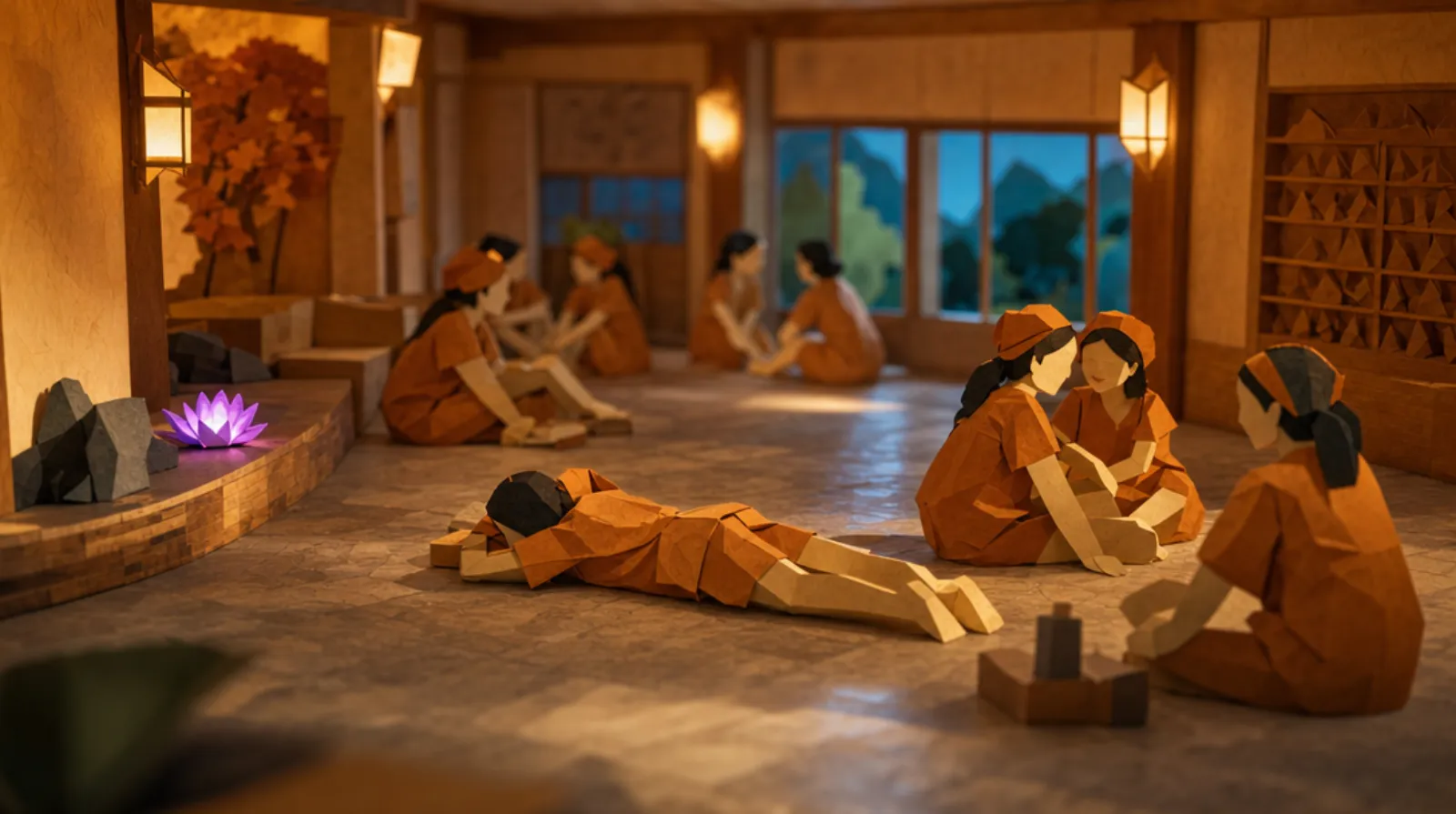
The bathhouse is part of it too. Korean 찜질방 (jjimjilbang) aren't spas in the Western sense — they're social infrastructure. People go regularly for soaks, scrubs, rest, and conversation. Extended heat exposure, lying on heated stone floors, isn't medically trivial: passive warmth increases circulation and carries some of the restorative benefits of low-intensity movement. My halmeoni went for the gossip. Her body didn't distinguish.
Your body is counting all of it, not just the hour
Your body tracks movement across the whole day, not just the hour at the gym — and most of us have swapped one for the other. A long day of sitting followed by an hour at the gym is metabolically much less powerful than a day of low-level continuous activity. Insulin sensitivity and inflammation markers both track more closely to how much you've moved through the whole day than to whether you hit a morning workout.
This matters especially across years. Bone density responds to peak load — the impact force of each step landed, each stair climbed. Muscle maintenance benefits from repeated loading across the day. My halmeoni had both. Every time she climbed four flights of stairs, each step delivered a real osteogenic signal and her hip stabilisers fired. Every time she squatted to the floor to mop, her knees tracked and her core engaged. Load-bearing movement, threaded through an ordinary day.

After I left clinical practice, I kept returning to one observation: the patients who aged best — maintained function into their seventies and eighties, stayed out of hospital, kept their minds clear — were almost never the ones who'd been athletic in their forties. They were the ones who'd never stopped moving in ordinary ways. The gardeners. The people who still cooked every meal and thought nothing of washing up. The ones who mopped their own floors.
What they had in common wasn't fitness. It was that they'd never separated movement from life.
The structural change, not the motivational one
Structural changes stick. Motivational ones don't.
Stand when you'd normally sit. Walk when you'd normally ride two stops. Make the stairs a permanent default — removed from daily deliberation, not a fresh decision each morning. Cook a meal rather than ordering: the standing, the stirring, the washing up accumulates across a week in ways that register in the body. Carry your groceries rather than having them delivered.
This isn't an argument against the gym. If lifting makes you feel good, keep lifting. If running clears your head, run. But if you exercise for an hour and then sit for twelve — which describes most people who exercise regularly — your metabolic markers may still not look like someone who moves throughout the day. The workout matters; it just doesn't fully substitute for fewer sitting hours. And if you're not exercising at all, the gap between doing nothing and walking a lot is far larger than the gap between walking and having a gym membership.
None of this feels like fitness. That's the whole point.
My halmeoni never tracked any of this. She'd have found the concept genuinely baffling. But if you'd mapped her daily movement against any clinical wellness metric, she'd outperform most people half her age.
She still mops her own floor. She's eighty-nine, and the corners, I can confirm, get done right.