Skip to content

Be Like Water

The best operators don't force outcomes. They find the path of least resistance, then quietly make it the only path anyone takes.

Essay · 15 June 2026 · 5 min read

My poh-poh ran a congee stall in Sham Shui Po for thirty-one years. If you'd asked her for a growth strategy, she'd have handed you a bowl and told you to sit down.

But she was running one of the tightest operations I've ever studied. The suppliers came at five-fifteen, so she was there at five. The broth needed six hours at a low simmer, so the fire was lit by five-thirty. Lunch peaked at noon, so the pot was ready at eleven-thirty — never early, never late. She'd built the whole business around a single fixed constraint, the broth's timeline, and let everything else fall in behind it.

She never called it a system. It was the best one I've ever seen.

Water isn't the soft option

Everyone knows the line from Bruce Lee: be like water. It gets quoted to mean go easy, stay loose, don't force things. That's the wrong half of it.

Water isn't gentle. It carved the Grand Canyon, layer by layer, over five million years. What it does is refuse to spend effort it doesn't have to — it finds the lowest point, goes there, and doesn't stop going there. Patient and relentless turn out to be the same trait, measured over different timeframes. 唔怕慢, 只怕站 (m̀h pa maahn, jí pa jaahm), my poh-poh used to say — don't fear going slow, only fear standing still.

A paper-craft mountain stream in the misty hills above Hong Kong: the current splits gently around a large boulder and rejoins beyond it, while a small figure sits with his back to us, watching.
It doesn't fight the rock. It finds the way around — and never stops.

I spent my first decade as an operator doing the opposite. I treated effort as the lever: work harder, push more, get further. That works right up until you're standing at a wall, shoving, with a door six feet to your left.

Find the constraint

Here's what I had backwards for years: I thought output was a function of effort. It's a function of the bottleneck.

Later, as a COO, I watched the same thing in every operation I ran. The work that flowed had a clean handoff and one owner per decision. The work that stalled, stalled in the same place every time — a missing input, or a person who was the only one who knew a thing. And piling more effort upstream of that point didn't move more work through it. It just stacked up in front of the constraint, waiting.

That's the operator's version of being like water. Stop pushing on the whole system. Find the one point where the resistance actually is, and put your attention there. Everywhere else, take the path of least resistance on purpose.

Make the right path the only easy one

The best systems don't rely on anyone trying harder. They make the correct move the path of least resistance — and the wrong move faintly annoying.

Manufacturing has a name for it: poka-yoke, error-proofing. A USB plug that only fits one way. A car that won't leave park until your foot's on the brake. You're not depending on memory or discipline. You've shaped the system so the right action is simply the easiest one available.

My poh-poh did this without the vocabulary. One pot. No substitutions, no off-menu requests. You got what was in the pot, or you ate somewhere else. She'd narrowed the path until it only ran one direction — and the people who walked it came back the next day, and the next.

A paper-craft Sham Shui Po lane at dawn: one warmly-lit, well-worn path leads to a single glowing soup stall while the side alleys sit dark, as small figures walk the lit way.
Narrow the path until it only runs one way. Then it runs itself.

The friction you've stopped seeing

The thing that quietly kills most operations isn't laziness. It's friction you've stopped noticing because you've spent years routing around it.

Do the arithmetic. A step that takes thirty seconds, run a hundred times a day, is fifty minutes — every day. Across a team of ten, that's most of a full-time role disappearing into a step nobody chose. And the longer it's there, the harder it is to see: first it's a workaround, then it's a habit, then it's "how we do things."

The fix isn't to move through it faster. Stop. Look straight at it. Ask whether it needs to exist.

It usually doesn't.

My poh-poh retired at sixty-six — not because trade dropped off, but because she was ready. She'd built something that ran on its own rhythm. It didn't need her to force it. She'd found the natural shape of the thing and arranged everything else around it, and after thirty-one years the path was so worn it ran itself.

Find the constraint. Work with the grain. Be patient.

Water always gets through.

All essays

The independent AI studio of Sean Melis · London

Build what you’ve been putting off.

Solve a problem that keeps coming back. Learn to build with AI. Or start with a course, app or tool I have already made.

Why this matters

AI can help you do more. You still decide what is good.

AI can handle work that repeats and help turn an idea into a first version. You decide what matters. I help you build it.

Click or press Enter to play or pause. Press Escape to close the theatre. 02:25 · stills, music and captions
Meet Sean · London

Ten years of using AI to solve real problems.

I’m Sean Melis. I use AI to solve problems in my own work and with clients. When something works, I turn it into a course, app or tool you can use too.

A tactile Polaroid of Sean Melis drinking a beer, captioned ‘the internet can feel different’
Proof of the work

Ten years of building and teaching.

30,000+Students taught
50+Projects, startup to enterprise
2017–2023Co-founded an AI agency and startup
10+Industries, sport to beauty to banking
Automation consultingat Deloitte
AI agent innovationat PA Consulting
“Captured our brand personality perfectly—professional, authentic, and playful.”Tahlia Sher · L’Oréal (CeraVe)
Selected clients
Find what you need

Choose where to start.

Start with what you want to learn, fix or make.

Arrival Choose one problem, one goal and one dream. 01 / The Arrivals Hall

New here? Start here.

AI Magic 2033

The Art of Living with Superintelligence

Seven acts and 44 chapters on using AI while keeping your judgement, taste and control.

  • Bring one problem, one goal and one dream
  • See Sean build with real working files
  • Make one useful first version
  • Keep the course tools in your Studio
The foundation course · $197 · Coming soon
Is this you?

For people with an idea to build or a problem to solve.

You do not need to be technical. You do need to stay curious, make decisions and care about the result.

This is for youif…

  • you have an idea but no technical team
  • the same task steals time every week
  • you want help without losing your voice or choices

It may not be for youif…

  • you want guaranteed money or instant success
  • you want AI to make every decision for you
  • you want AI to produce lots of work, rather than help you finish something useful
And one more thing

You don’t have to buy anything. You still get this.

An account costs nothing, and there is no trial to cancel. It opens a room of tools, libraries and small apps you can start using today.

Your Studio · live product preview
A look inside the StudioStudio preview
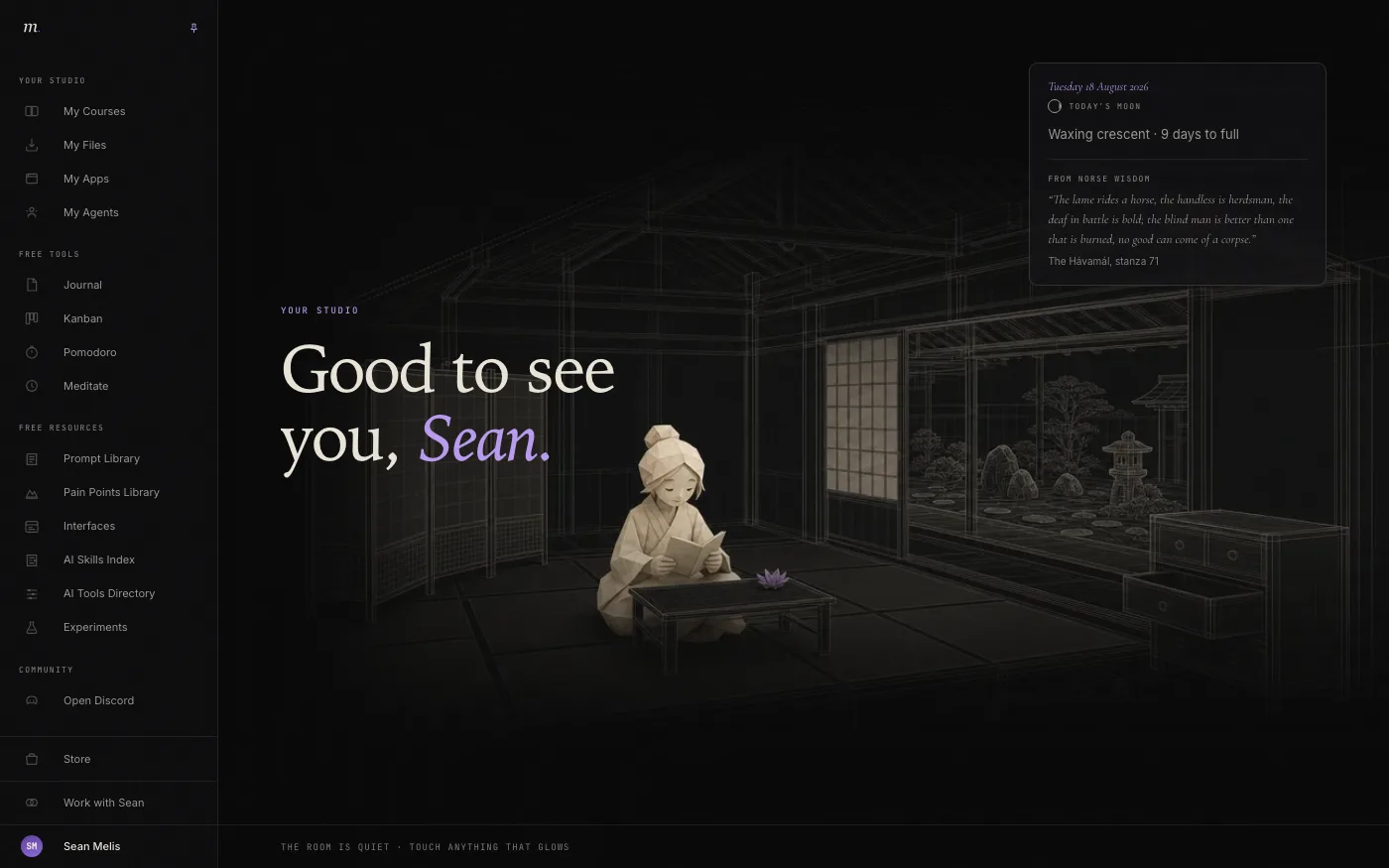
Your Studio
The Studio open on a desktop, showing the room and its side rail.
The same Studio on a phone.
A look inside the StudioWider on a desktop
Inside the Studio

Join once. Get all of this free.

The shop is where you find things. Your Studio is where they live. Anything you buy lands there too, everything runs in your browser, and your work stays private.

  • 365 promptsPrompt Library
  • 50 pain pointsProblems worth solving
  • 50 AI skillsSkills Index
  • 50 AI toolsTools Directory
  • ExperimentsBrowser-only tools
  • Private journalThink things through
  • Simple KanbanTo Do, Doing, Done
  • Focus timerPomodoro
  • Meditation timerA quiet pause
  • Interface galleryUseful patterns
No card required
Loading available times…
Custom work · By application

What do you want to build?

Tell me what you want built. I read every one, and reply if it’s a fit.

Aetherboard

One infinite whiteboard that lives on your Mac.

Try Aetherboard ↗ $99$49 onceFounding Owner

$99 after the first 100. Yours permanently, with 12 months of updates.

Mac, offline. You get the files and readable source.

Founding price$49 once
OwnershipFiles + readable source
Works onMac · offline
Standard price$99 after 100
The Aetherboard canvas: handwritten headings, sticky notes, pinned pictures and the tool bar along the bottom $99$49 onceFounding Owner
A calm paper-crafted workspace inside Aetherboard

Stop renting your thoughts. Own the board.

Try the real canvas in your browser. The first 100 owners pay $49 once, keep the Mac app permanently and receive 12 months of updates. The standard price is $99.

Pages, products and essays↑↓ move↵ openesc close