Skip to content

The Decisions That Compound

The business is built by a hundred small, boring decisions you make on a Tuesday — not the pivots and term sheets everyone puts in the retrospective.

Field note · 4 January 2026 · 4 min read

The most consequential decision I made at my last company wasn't the pricing model or the market we chose to enter.

It was a two-sentence internal policy about the handoff from sales to onboarding.

No ceremony around it. I wrote it after a quarterly review where I'd spotted a pattern in early churn — the same customer confusion, at the same stage, the same missing piece of information. I put down in plain language what the handoff needed to include and who owned it. Posted it in Slack. Two people acknowledged it. Nobody called it important.

Six months later the problem was gone. That policy outlasted half the people who ever read it.

A paper-craft scene: worn concave stone steps in a Hong Kong tenement stairwell, a small figure seen from behind partway up, a faded red blessing paper pinned to the wall beside the landing.
No single step wore them down. That's the whole point.

The big bets create the container

The pivot, the term sheet, the enterprise anchor deal — those get the all-hands and the retrospective board slide. They set the direction.

But direction isn't the constraint. I've watched enough companies build, and lose, to know that what fills the container is what you decide between the big moments: the handoff policy, the support template, the hiring bar you quietly lower when you're rushed. Most founders can name the strategic bets. Almost none can name the small decisions that ran the business underneath them.

Morgan Housel writes in The Psychology of Money that compounding doesn't look impressive until suddenly it does — the curve is flat, flat, flat, then steep. The same dynamic runs through operational decisions. You can't see it moving while it's moving. A process that's slightly less broken each quarter becomes a sound one by year-end. A team that gets marginally better at communicating becomes genuinely good in three years. Not because anyone tracked the improvement — because the decisions ran consistently in one direction, long enough for the curve to turn.

There's a Cantonese proverb my poh-poh kept near the stall: 唔怕慢,只怕站 — m̀h pa maahn, jí pa jaahm. Don't fear going slow; only fear standing still. She meant patience. I've come to think she was also describing operations.

The wrong kind of debt doesn't announce itself

Bad small decisions compound with equal reliability, just in the other direction.

I've seen this happen with something as minor as an email template. A founder writes a quick reply to a difficult customer — late Thursday, tired — and it lands dismissive. No crisis. The next person handling that issue finds the old thread and follows the pattern because it looks like precedent. Then the next person. By the time I traced it, that template had run through an estimated twelve hundred customer conversations over three years. Nobody had audited it because nobody thought it was important. It turned out to be the explanation for the worst-performing cohort in our entire customer base.

Nobody remembers the Thursday.

Workarounds are the particularly dangerous version of this. A workaround isn't a decision — it's a deferred one. The debt it creates collects quietly, and you discover the balance on a bad week, when the patchwork fails at the moment it can least afford to.

The question I run before calling any decision minor

Before any decision that feels small, I ask one thing: does it compound?

Three sub-questions, in order:

  • Does it make the next person's job easier or harder?
  • Does it close a gap or paper over one?
  • Am I making a decision or constructing a workaround?

The decisions worth protecting aren't the glamorous ones. They're the ones nobody will think to revisit — because nobody noticed they were made. That's what makes them dangerous when they're wrong, and durable when they're right.

This is also why I'm suspicious of the phrase "we'll sort that out later." Later is where compounding lives. The small thing you deferred is being run right now by someone who found the old way and assumed it was correct.

The stall ran for thirty-one years

My poh-poh was offered a second location early in the life of her stall — a bigger space in Sham Shui Po, more seats, more volume. She turned it down. Her reason: she'd have to trust strangers making her soup, and she didn't believe she could hold the quality.

She probably left money on the table.

A paper-craft miniature of a narrow Sham Shui Po cooked food stall, an elderly Cantonese woman seen from behind adjusting the lid of a clay sand pot at the counter, identical ceramic soup bowls stacked in precise rows on the shelf behind her, a faded hand-painted red signboard with Cantonese characters above the entrance.
Three decades of compounding on the one thing she actually controlled.

The original stall ran for thirty-one years without a bad bowl. One decision not to scale. Three decades of compounding on the thing she actually controlled.

The big strategic call she didn't make is the easy one to remember. What kept the quality is what she decided, every morning, about the broth.


All essays

The independent AI studio of Sean Melis · London

Build what you’ve been putting off.

Solve a problem that keeps coming back. Learn to build with AI. Or start with a course, app or tool I have already made.

Why this matters

AI can help you do more. You still decide what is good.

AI can handle work that repeats and help turn an idea into a first version. You decide what matters. I help you build it.

Click or press Enter to play or pause. Press Escape to close the theatre. 02:25 · stills, music and captions
Meet Sean · London

Ten years of using AI to solve real problems.

I’m Sean Melis. I use AI to solve problems in my own work and with clients. When something works, I turn it into a course, app or tool you can use too.

A tactile Polaroid of Sean Melis drinking a beer, captioned ‘the internet can feel different’
Proof of the work

Ten years of building and teaching.

30,000+Students taught
50+Projects, startup to enterprise
2017–2023Co-founded an AI agency and startup
10+Industries, sport to beauty to banking
Automation consultingat Deloitte
AI agent innovationat PA Consulting
“Captured our brand personality perfectly—professional, authentic, and playful.”Tahlia Sher · L’Oréal (CeraVe)
Selected clients
Find what you need

Choose where to start.

Start with what you want to learn, fix or make.

Arrival Choose one problem, one goal and one dream. 01 / The Arrivals Hall

New here? Start here.

AI Magic 2033

The Art of Living with Superintelligence

Seven acts and 44 chapters on using AI while keeping your judgement, taste and control.

  • Bring one problem, one goal and one dream
  • See Sean build with real working files
  • Make one useful first version
  • Keep the course tools in your Studio
The foundation course · $197 · Coming soon
Is this you?

For people with an idea to build or a problem to solve.

You do not need to be technical. You do need to stay curious, make decisions and care about the result.

This is for youif…

  • you have an idea but no technical team
  • the same task steals time every week
  • you want help without losing your voice or choices

It may not be for youif…

  • you want guaranteed money or instant success
  • you want AI to make every decision for you
  • you want AI to produce lots of work, rather than help you finish something useful
And one more thing

You don’t have to buy anything. You still get this.

An account costs nothing, and there is no trial to cancel. It opens a room of tools, libraries and small apps you can start using today.

Your Studio · live product preview
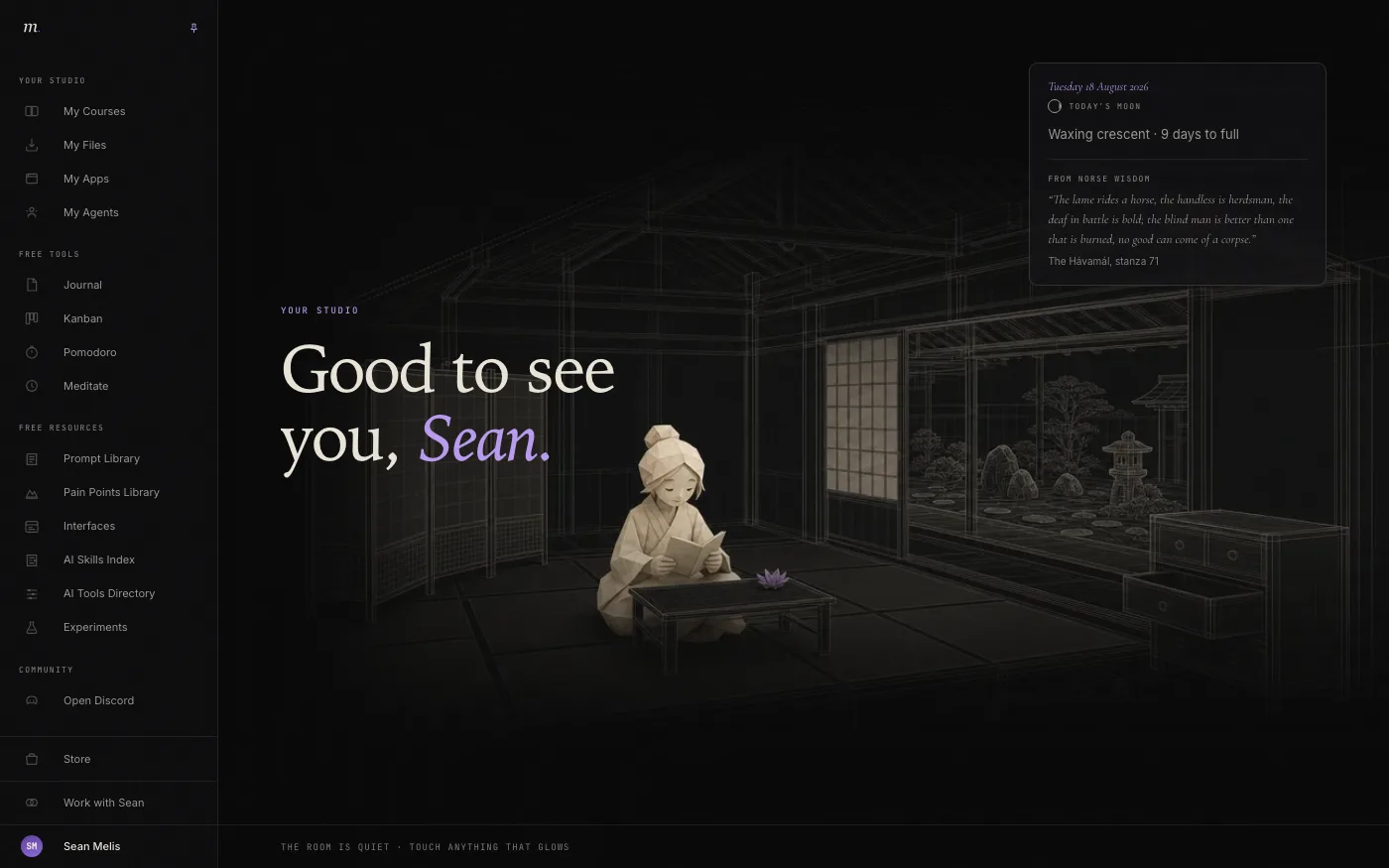
A look inside the StudioStudio preview
Your Studio
The Studio open on a desktop, showing the room and its side rail.
The same Studio on a phone.
A look inside the StudioWider on a desktop
Inside the Studio

Join once. Get all of this free.

The shop is where you find things. Your Studio is where they live. Anything you buy lands there too, everything runs in your browser, and your work stays private.

  • 365 promptsPrompt Library
  • 50 pain pointsProblems worth solving
  • 50 AI skillsSkills Index
  • 50 AI toolsTools Directory
  • ExperimentsBrowser-only tools
  • Private journalThink things through
  • Simple KanbanTo Do, Doing, Done
  • Focus timerPomodoro
  • Meditation timerA quiet pause
  • Interface galleryUseful patterns
No card required
Loading available times…
Custom work · By application

What do you want to build?

Tell me what you want built. I read every one, and reply if it’s a fit.

Aetherboard

One infinite whiteboard that lives on your Mac.

Try Aetherboard ↗ $99$49 onceFounding Owner

$99 after the first 100. Yours permanently, with 12 months of updates.

Mac, offline. You get the files and readable source.

Founding price$49 once
OwnershipFiles + readable source
Works onMac · offline
Standard price$99 after 100
The Aetherboard canvas: handwritten headings, sticky notes, pinned pictures and the tool bar along the bottom $99$49 onceFounding Owner
A calm paper-crafted workspace inside Aetherboard

Stop renting your thoughts. Own the board.

Try the real canvas in your browser. The first 100 owners pay $49 once, keep the Mac app permanently and receive 12 months of updates. The standard price is $99.

Pages, products and essays↑↓ move↵ openesc close