Skip to content

The Detail Nobody Asked For

The small considered touches no one briefs for are what separate 'fine' from unforgettable — a field note on caring too much.

Field note · 26 December 2025 · 4 min read

The client never asked for the sound of the paper.

I was working on a short film with a budget that was, diplomatically, thin. We were shooting a scene of a woman reading a letter — the old kind, written on good stationery, folded into thirds, slid into a cream envelope. In rehearsal, I could hear the paper. The weight of it. The slight resistance when she unfolded it.

The brief said nothing about the letter. It was a prop.

I made the production designer source a specific weight of cotton-rag paper from a stationer on the edge of town. It cost three times what ordinary paper would have. It arrived two days late, which was a problem. The director looked at me like I'd lost my mind.

In the final edit, you can't see the paper. You can hear it — just barely, under the ambient room tone. Three seconds. Maybe four.

Everyone who has seen that scene says it feels real. Nobody has mentioned the paper.
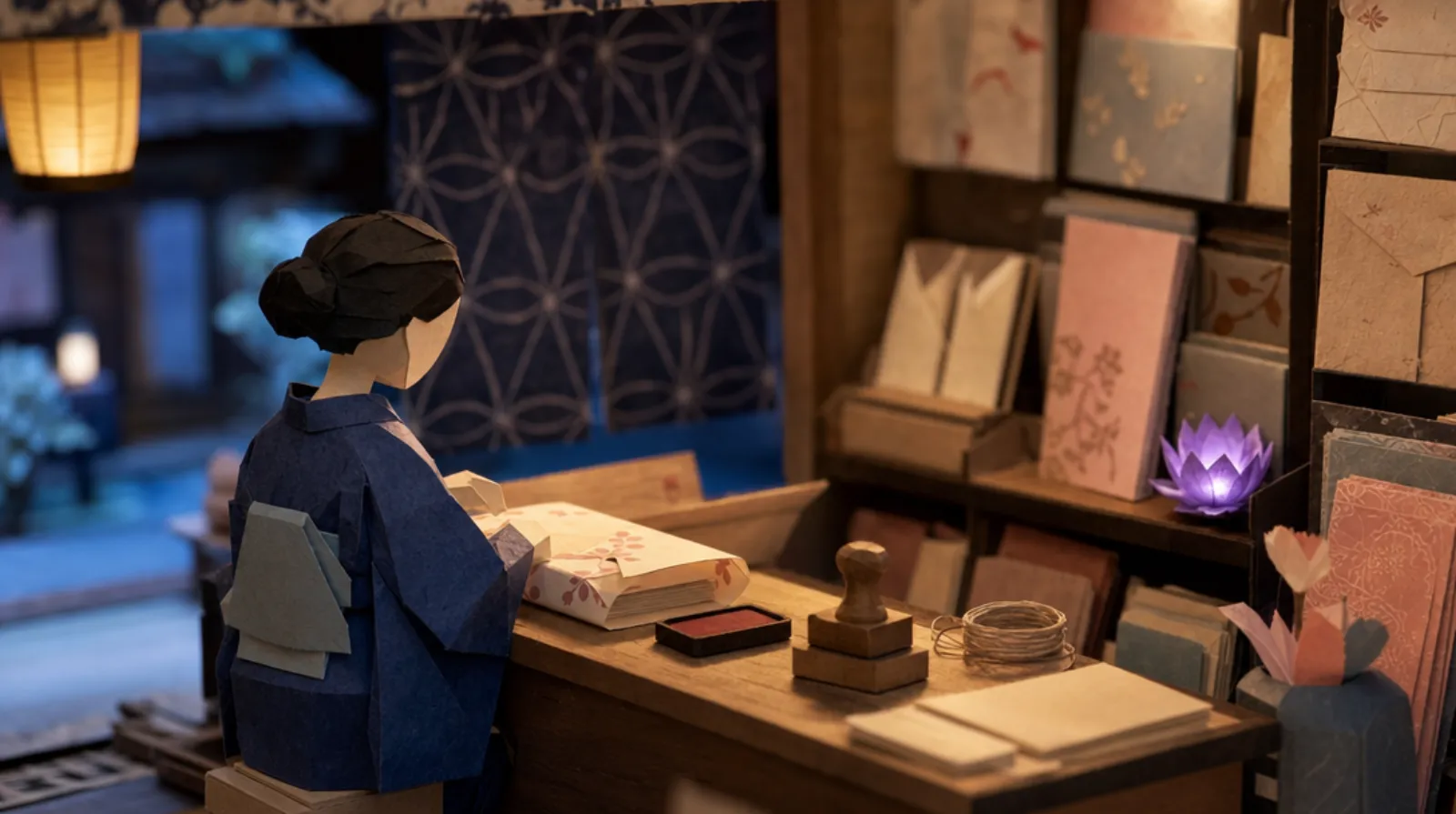
A paper-craft miniature of a small Japanese stationery shop interior, where a woman seen from behind adjusts the fold of wrapping paper around a stack of letters at a low wooden counter, a noren curtain visible in the background.
The fold nobody sees is the one that makes you feel the whole thing was made with care.

A brief is a floor, not a ceiling

A brief tells you what someone needs to not be embarrassed — the things they've planned for, budgeted against. What it can never contain are the things they haven't yet imagined needing.

That gap — between what was planned and what becomes memorable — is where the actual work lives.

I've heard "what's not in the brief isn't our problem" from competent people who delivered exactly what was asked and produced nothing worth remembering. The brief is useful. It doesn't tell you how good to be.

You feel it. You won't find it.

A good restaurant doesn't print the chef's name on the menu and expect you to feel cared for. You feel cared for because the bread arrives warm, because the candle placement is considered, because the person taking your order actually looks at you. None of this is in any specification.

It accumulates. Atmosphere is the word we use for considered decisions compounding quietly over time.

The brands that feel finished, settled, somehow complete — they've made dozens of choices nobody requested. You sense them without finding them. The hollow ones? Usually they met the brief and stopped.

Obsession, held as craft

There's a word in Japanese culture — kodawari — that translates inadequately as "attachment to detail" or "insistence on quality." The inadequacy is in the translation. Kodawari is obsession — the word literally means that. What Japanese culture does differently is hold that fixation as a mark of craft rather than a disorder. A refusal to let something be merely adequate when it could be exact.

It's why a ramen chef spends decades on one broth. Why the packaging on certain Japanese stationery is considered as carefully as what's inside.

The paper matters because the paper always mattered. They just didn't put it in the brief.

A paper-craft miniature of a spare Japanese ramen kitchen after service hours, where a Japanese-heritage woman, back turned and small in the lower portion of the frame, holds a ceramic bowl of dark broth up to her face to smell it, a worn handwritten recipe card pinned to the tiled wall behind her beside a single large steel pot.
Decades on one broth. Not because perfection exists, but because exact and adequate are different words.

Look for the thing the brief forgot to ask for

I keep a note in my process documents — not a rule, more of a prompt — that says: look for the thing the brief forgot to ask for.

It's almost always there. The transition that's abrupt when it could be graceful. The sound design that's functional when it could be evocative. The detail in frame nobody will consciously notice but that makes a shot feel inhabited rather than staged.

This isn't about perfectionism or spending more. It's about having a point of view — specifically, about what this piece of work could be, beyond what was asked. That's the discipline. It's also the only thing that separates work people remember from work they simply couldn't fault.

What has yours forgotten to ask for?

---

Kiko finds the exact patch of sunlight in the room every morning and sits in it, perfectly composed. I've tried to recreate this as a deliberate shot, twice, and never matched it. She's not trying to be beautiful. She has strong opinions about where to be.

The detail nobody asked for comes from exactly that.

All essays

The independent AI studio of Sean Melis · London

Build what you’ve been putting off.

Solve a problem that keeps coming back. Learn to build with AI. Or start with a course, app or tool I have already made.

Why this matters

AI can help you do more. You still decide what is good.

AI can handle work that repeats and help turn an idea into a first version. You decide what matters. I help you build it.

Click or press Enter to play or pause. Press Escape to close the theatre. 02:25 · stills, music and captions
Meet Sean · London

Ten years of using AI to solve real problems.

I’m Sean Melis. I use AI to solve problems in my own work and with clients. When something works, I turn it into a course, app or tool you can use too.

A tactile Polaroid of Sean Melis drinking a beer, captioned ‘the internet can feel different’
Proof of the work

Ten years of building and teaching.

30,000+Students taught
50+Projects, startup to enterprise
2017–2023Co-founded an AI agency and startup
10+Industries, sport to beauty to banking
Automation consultingat Deloitte
AI agent innovationat PA Consulting
“Captured our brand personality perfectly—professional, authentic, and playful.”Tahlia Sher · L’Oréal (CeraVe)
Selected clients
Find what you need

Choose where to start.

Start with what you want to learn, fix or make.

Arrival Choose one problem, one goal and one dream. 01 / The Arrivals Hall

New here? Start here.

AI Magic 2033

The Art of Living with Superintelligence

Seven acts and 44 chapters on using AI while keeping your judgement, taste and control.

  • Bring one problem, one goal and one dream
  • See Sean build with real working files
  • Make one useful first version
  • Keep the course tools in your Studio
The foundation course · $197 · Coming soon
Is this you?

For people with an idea to build or a problem to solve.

You do not need to be technical. You do need to stay curious, make decisions and care about the result.

This is for youif…

  • you have an idea but no technical team
  • the same task steals time every week
  • you want help without losing your voice or choices

It may not be for youif…

  • you want guaranteed money or instant success
  • you want AI to make every decision for you
  • you want AI to produce lots of work, rather than help you finish something useful
And one more thing

You don’t have to buy anything. You still get this.

An account costs nothing, and there is no trial to cancel. It opens a room of tools, libraries and small apps you can start using today.

Your Studio · live product preview
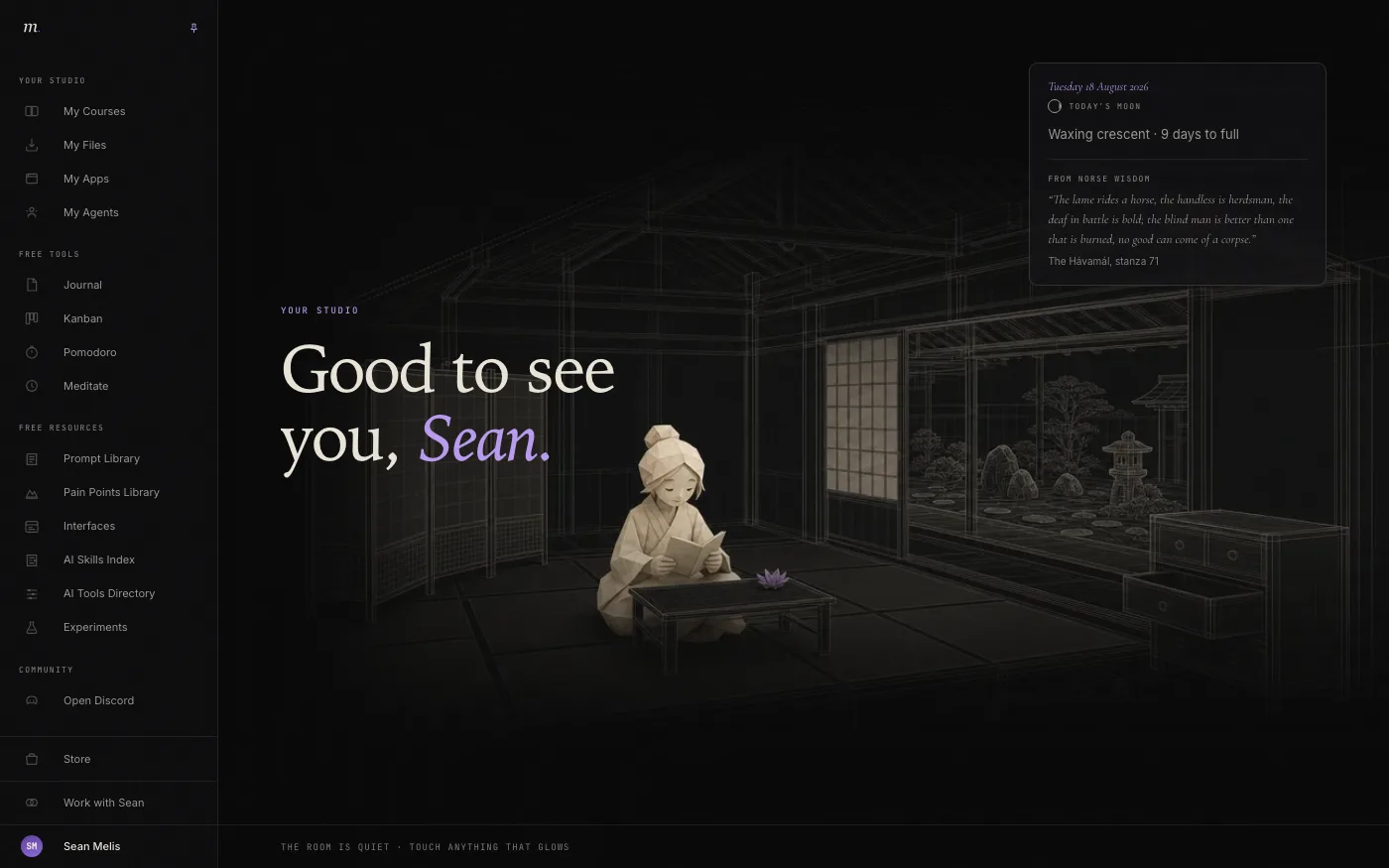
A look inside the StudioStudio preview
Your Studio
The Studio open on a desktop, showing the room and its side rail.
The same Studio on a phone.
A look inside the StudioWider on a desktop
Inside the Studio

Join once. Get all of this free.

The shop is where you find things. Your Studio is where they live. Anything you buy lands there too, everything runs in your browser, and your work stays private.

  • 365 promptsPrompt Library
  • 50 pain pointsProblems worth solving
  • 50 AI skillsSkills Index
  • 50 AI toolsTools Directory
  • ExperimentsBrowser-only tools
  • Private journalThink things through
  • Simple KanbanTo Do, Doing, Done
  • Focus timerPomodoro
  • Meditation timerA quiet pause
  • Interface galleryUseful patterns
No card required
Loading available times…
Custom work · By application

What do you want to build?

Tell me what you want built. I read every one, and reply if it’s a fit.

Aetherboard

One infinite whiteboard that lives on your Mac.

Try Aetherboard ↗ $99$49 onceFounding Owner

$99 after the first 100. Yours permanently, with 12 months of updates.

Mac, offline. You get the files and readable source.

Founding price$49 once
OwnershipFiles + readable source
Works onMac · offline
Standard price$99 after 100
The Aetherboard canvas: handwritten headings, sticky notes, pinned pictures and the tool bar along the bottom $99$49 onceFounding Owner
A calm paper-crafted workspace inside Aetherboard

Stop renting your thoughts. Own the board.

Try the real canvas in your browser. The first 100 owners pay $49 once, keep the Mac app permanently and receive 12 months of updates. The standard price is $99.

Pages, products and essays↑↓ move↵ openesc close