Skip to content

Know When to Whisper

Most brands waste their best story by shouting it — restraint isn't the absence of confidence, it's the loudest signal of it.

Essay · 6 June 2026 · 5 min read

There's a shop on Nishiki Market — the narrow covered passage they call Kyoto's Kitchen — that sells pickled plum paste in plain white jars. No logo. No founding story. Just the jar, a single kanji character, and the smell of something that has been patient for a very long time.

I've watched tourists walk past it a dozen times before one of them stops, squints, and reaches for it.

That jar communicates more in a centimetre of label than most brand decks do in forty slides.

What you're actually saying when you shout

Every extra word in your brand copy is a vote of no confidence in your audience.

The instinct to fill space is understandable. You've made something you're proud of, the market is loud, and silence feels irresponsible. So you say it in the headline and the subhead and the caption. Value proposition over the hero image. Testimonial below the fold. Trust badge next to the cart button. Popup when someone tries to leave.

By the time a person reaches for what you made, they're exhausted.

Loudness reads as anxiety. Anxiety is not a quality attribute.

My editor saw it before I did

You can't reason your way to restraint. I had to cut it out of a film.

I was editing a fifteen-minute piece — a woman returning to her childhood home after her father's death — and the ending wouldn't resolve. I kept adding: music, a close-up held too long, a final line of dialogue that explained what the images already showed.

Sachi, my editor, watched the cut and then sat in silence.

"You don't trust the audience," she said. Not unkindly. Just as fact.

She was right. When we stripped the music, cut the final line, let a shot of an empty chair hold for two seconds longer than felt comfortable — the scene became the best thing in the film. People brought it up in the Q&A. Nobody mentioned the music.

Restraint doesn't make things smaller. It makes room for the audience to arrive.
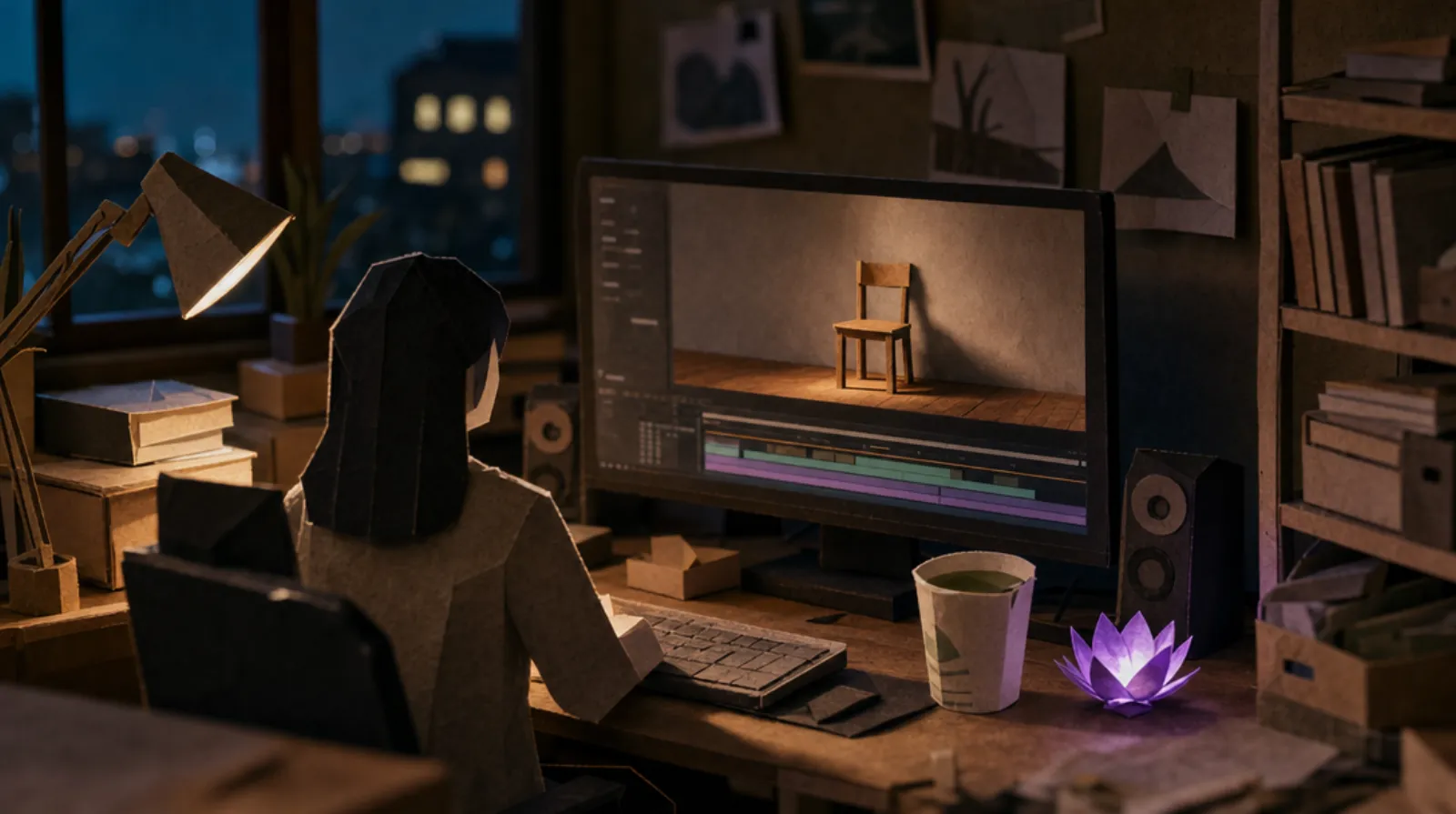
A Japanese-heritage woman sits small in a darkened editing suite, her back to the viewer, facing a monitor paused on a single frame of an empty wooden chair, a faint editing timeline glowing in strips below the image, a half-drunk convenience-store paper cup of green tea on the corner of the desk.
The cut you're afraid to make is almost always the one the film needs.

The whisper only works when it's earned

The brands that stay with me are the ones that seem to trust me. They give me enough and then stop.

Patagonia ran a full-page advertisement in the New York Times on Black Friday with the headline: "Don't Buy This Jacket." The copy talked about the environmental cost of making their own product — told customers, in effect, to think before spending.

Sales rose roughly 30% the following year — though how much of that the ad moved, versus a brand already on a sustained growth trajectory, has never been isolated.

I'm not suggesting every brand do this. It worked because Patagonia had already built the credibility for the message to land as conviction rather than performance. That's the clause most briefs leave out: restraint is a position you earn, not a posture you adopt. The whisper lands only when the room already knows you have something worth saying.

A Japanese-heritage woman stands at the far end of a narrow covered market lane, her back to the viewer, looking at a sparse shelf of plain white jars, one jar set apart by the faintest variation in its glaze.
The ones that don't announce themselves are the ones you come back for.

Ma: the gap that does the work

Most brands I read don't have a copywriting problem. They have a ma problem.

(ma) is a Japanese concept usually translated as negative space, though that flattens it considerably. It's closer to the meaningful pause between things. The silence that gives a note its weight. A room is not just the objects in it; it's also the air between them.

Good brand storytelling has ma. There are things it doesn't say. Choices it doesn't explain. Silence it holds while you catch up.

This is not the same as vagueness. Vagueness is a failure of nerve. Restraint is a choice — a confident one. You know what you want to say, you've said the essential part, and you've had the discipline to stop. Too much, too fast, no space for meaning to land: that's where most brand work fails. Not in the execution. In the volume.

One question before every project

Kiko — my Shiba Inu, primary audience of all first drafts — has understood this her entire life. She sits by the door when she wants a walk. No barking, no dramatics. Just the sit, the wait, the look. She gets the walk every time.

There's one question I ask before every project begins. Not a rule — a temperature check.

Are you whispering because you're confident, or because you're afraid?

The two can look identical from the outside. Internally, they feel nothing alike. Confidence is choosing to hold back, trusting the work to carry what's left unsaid. Fear is hoping nobody looks too closely. One is ma. The other is just silence.

Get that right and the brief mostly writes itself.

The jar on Nishiki sold out before noon the day I finally bought one. I had to come back three times.

It's very good plum paste.

All essays

The independent AI studio of Sean Melis · London

Build what you’ve been putting off.

Solve a problem that keeps coming back. Learn to build with AI. Or start with a course, app or tool I have already made.

Why this matters

AI can help you do more. You still decide what is good.

AI can handle work that repeats and help turn an idea into a first version. You decide what matters. I help you build it.

Click or press Enter to play or pause. Press Escape to close the theatre. 02:25 · stills, music and captions
Meet Sean · London

Ten years of using AI to solve real problems.

I’m Sean Melis. I use AI to solve problems in my own work and with clients. When something works, I turn it into a course, app or tool you can use too.

A tactile Polaroid of Sean Melis drinking a beer, captioned ‘the internet can feel different’
Proof of the work

Ten years of building and teaching.

30,000+Students taught
50+Projects, startup to enterprise
2017–2023Co-founded an AI agency and startup
10+Industries, sport to beauty to banking
Automation consultingat Deloitte
AI agent innovationat PA Consulting
“Captured our brand personality perfectly—professional, authentic, and playful.”Tahlia Sher · L’Oréal (CeraVe)
Selected clients
Find what you need

Choose where to start.

Start with what you want to learn, fix or make.

Arrival Choose one problem, one goal and one dream. 01 / The Arrivals Hall

New here? Start here.

AI Magic 2033

The Art of Living with Superintelligence

Seven acts and 44 chapters on using AI while keeping your judgement, taste and control.

  • Bring one problem, one goal and one dream
  • See Sean build with real working files
  • Make one useful first version
  • Keep the course tools in your Studio
The foundation course · $197 · Coming soon
Is this you?

For people with an idea to build or a problem to solve.

You do not need to be technical. You do need to stay curious, make decisions and care about the result.

This is for youif…

  • you have an idea but no technical team
  • the same task steals time every week
  • you want help without losing your voice or choices

It may not be for youif…

  • you want guaranteed money or instant success
  • you want AI to make every decision for you
  • you want AI to produce lots of work, rather than help you finish something useful
And one more thing

You don’t have to buy anything. You still get this.

An account costs nothing, and there is no trial to cancel. It opens a room of tools, libraries and small apps you can start using today.

Your Studio · live product preview
A look inside the StudioStudio preview
Your Studio
The Studio open on a desktop, showing the room and its side rail.
The same Studio on a phone.
A look inside the StudioWider on a desktop
Inside the Studio

Join once. Get all of this free.

The shop is where you find things. Your Studio is where they live. Anything you buy lands there too, everything runs in your browser, and your work stays private.

  • 365 promptsPrompt Library
  • 50 pain pointsProblems worth solving
  • 50 AI skillsSkills Index
  • 50 AI toolsTools Directory
  • ExperimentsBrowser-only tools
  • Private journalThink things through
  • Simple KanbanTo Do, Doing, Done
  • Focus timerPomodoro
  • Meditation timerA quiet pause
  • Interface galleryUseful patterns
No card required
Loading available times…
Custom work · By application

What do you want to build?

Tell me what you want built. I read every one, and reply if it’s a fit.

Aetherboard

One infinite whiteboard that lives on your Mac.

Try Aetherboard ↗ $99$49 onceFounding Owner

$99 after the first 100. Yours permanently, with 12 months of updates.

Mac, offline. You get the files and readable source.

Founding price$49 once
OwnershipFiles + readable source
Works onMac · offline
Standard price$99 after 100
The Aetherboard canvas: handwritten headings, sticky notes, pinned pictures and the tool bar along the bottom $99$49 onceFounding Owner
A calm paper-crafted workspace inside Aetherboard

Stop renting your thoughts. Own the board.

Try the real canvas in your browser. The first 100 owners pay $49 once, keep the Mac app permanently and receive 12 months of updates. The standard price is $99.

Pages, products and essays↑↓ move↵ openesc close