Skip to content

Intention at the Centre

My grandmother's altar wasn't decoration — it was the home declaring what it was for, and every home that holds you has a centre like that.

Field note · 2 November 2025 · 4 min read

I didn't have a word for what my grandmother was doing until long after she was gone. She bought cempasúchil — thick, resinous marigolds, orange-gold, a scent halfway between earth and something you can't quite name — every Saturday from the same stall in the Oaxacan market. The altar sat in the centre of the main room. Never moved, never made smaller, never explained to visitors who might not understand.

I grew up thinking this was simply what houses had.

A paper-craft miniature living room where a long wooden table sits at the centre, a Mexican woman seated at its far end with her back to us, with potted plants leaning gently toward the table from the edges of the room.
Everything else arranges itself around where the living actually happens.

A room without a centre doesn't know what it's for

Most homes I've been in since don't have this — and you feel its absence before you can name it. The eye moves through the room without landing anywhere that means something. A slight unresolvedness. A room that knows what it looks like, but not what it's for.

The altar wasn't decoration. It was functional in the deepest sense: it declared, without anyone having to speak, what this house was for. Whose lives it remembered. What it kept returning to. The whole space had a centre of gravity, and everything else arranged itself, loosely and naturally, around that fact.

Two years of adjusting and I still hadn't found it

What my Copenhagen apartment was missing for two years wasn't furniture or light — it was a centre.

I was adjusting things, acquiring things, reading about Scandinavian interiors and feeling perpetually almost there. The apartment looked considered. Something essential was still absent, and I couldn't say what because I was looking in the wrong layer.

I found it eventually at the long table near the south-facing window. I write there, eat there, sit doing nothing in particular. Friends stay for hours without anyone noticing the time. The plants have moved toward it gradually — the monstera, the fig, the philodendron I've carried through two moves. Not according to any plan. They migrated, through small adjustments over time, toward where the living actually happens.

Once I understood that the table was the centre, the rest of the apartment made sense. Not visually — as a home. The other furniture knows what it's doing because there's something for it to be in relation to.

Decoration asks the wrong question

Most home advice works in two layers: aesthetic (does this look right?) or functional (does this work?). There's a third layer, and it's the one that holds.

Intention asks: what is this place for?

Those two questions produce different rooms. One produces something that photographs well. The other produces a room that holds a meal in a way that makes three hours disappear — that receives you at the end of a hard day and gives back something you couldn't have named.

A room can be arranged, even beautifully, without a centre. You've been in those rooms. Maintained but not nourished. You leave without carrying anything.

The tending needs somewhere to go

You don't need an altar. But your home needs something at its centre that means something to you — a table that is genuinely your table, a garden corner that holds a particular hour of a particular season, a shelf that isn't for display but for the active, ongoing relationship you have with what's on it.

Some place the room can quietly organise itself around.

Once you have that, the tending has somewhere to go. The candle you light on a particular evening, the plant you move toward the window, the flowers you buy not because they're seasonal but because this is what you do — all of it has a receiver. The home knows what it's for.

A paper-craft miniature Oaxacan market stall piled high with orange marigolds, a Mexican woman with her back to us reaching to choose a bunch, a handwritten price card in Spanish tucked among the stems.
She wasn't buying flowers. She was keeping a promise to a room that was waiting.

My grandmother's phrase was Sin altar, no hay hogar — without an altar, there is no home. She didn't mean you needed an altar. She meant the home needed a reason to be one.

That's what the marigolds were for.

All essays

The independent AI studio of Sean Melis · London

Build what you’ve been putting off.

Solve a problem that keeps coming back. Learn to build with AI. Or start with a course, app or tool I have already made.

Why this matters

AI can help you do more. You still decide what is good.

AI can handle work that repeats and help turn an idea into a first version. You decide what matters. I help you build it.

Click or press Enter to play or pause. Press Escape to close the theatre. 02:25 · stills, music and captions
Meet Sean · London

Ten years of using AI to solve real problems.

I’m Sean Melis. I use AI to solve problems in my own work and with clients. When something works, I turn it into a course, app or tool you can use too.

A tactile Polaroid of Sean Melis drinking a beer, captioned ‘the internet can feel different’
Proof of the work

Ten years of building and teaching.

30,000+Students taught
50+Projects, startup to enterprise
2017–2023Co-founded an AI agency and startup
10+Industries, sport to beauty to banking
Automation consultingat Deloitte
AI agent innovationat PA Consulting
“Captured our brand personality perfectly—professional, authentic, and playful.”Tahlia Sher · L’Oréal (CeraVe)
Selected clients
Find what you need

Choose where to start.

Start with what you want to learn, fix or make.

Arrival Choose one problem, one goal and one dream. 01 / The Arrivals Hall

New here? Start here.

AI Magic 2033

The Art of Living with Superintelligence

Seven acts and 44 chapters on using AI while keeping your judgement, taste and control.

  • Bring one problem, one goal and one dream
  • See Sean build with real working files
  • Make one useful first version
  • Keep the course tools in your Studio
The foundation course · $197 · Coming soon
Is this you?

For people with an idea to build or a problem to solve.

You do not need to be technical. You do need to stay curious, make decisions and care about the result.

This is for youif…

  • you have an idea but no technical team
  • the same task steals time every week
  • you want help without losing your voice or choices

It may not be for youif…

  • you want guaranteed money or instant success
  • you want AI to make every decision for you
  • you want AI to produce lots of work, rather than help you finish something useful
And one more thing

You don’t have to buy anything. You still get this.

An account costs nothing, and there is no trial to cancel. It opens a room of tools, libraries and small apps you can start using today.

Your Studio · live product preview
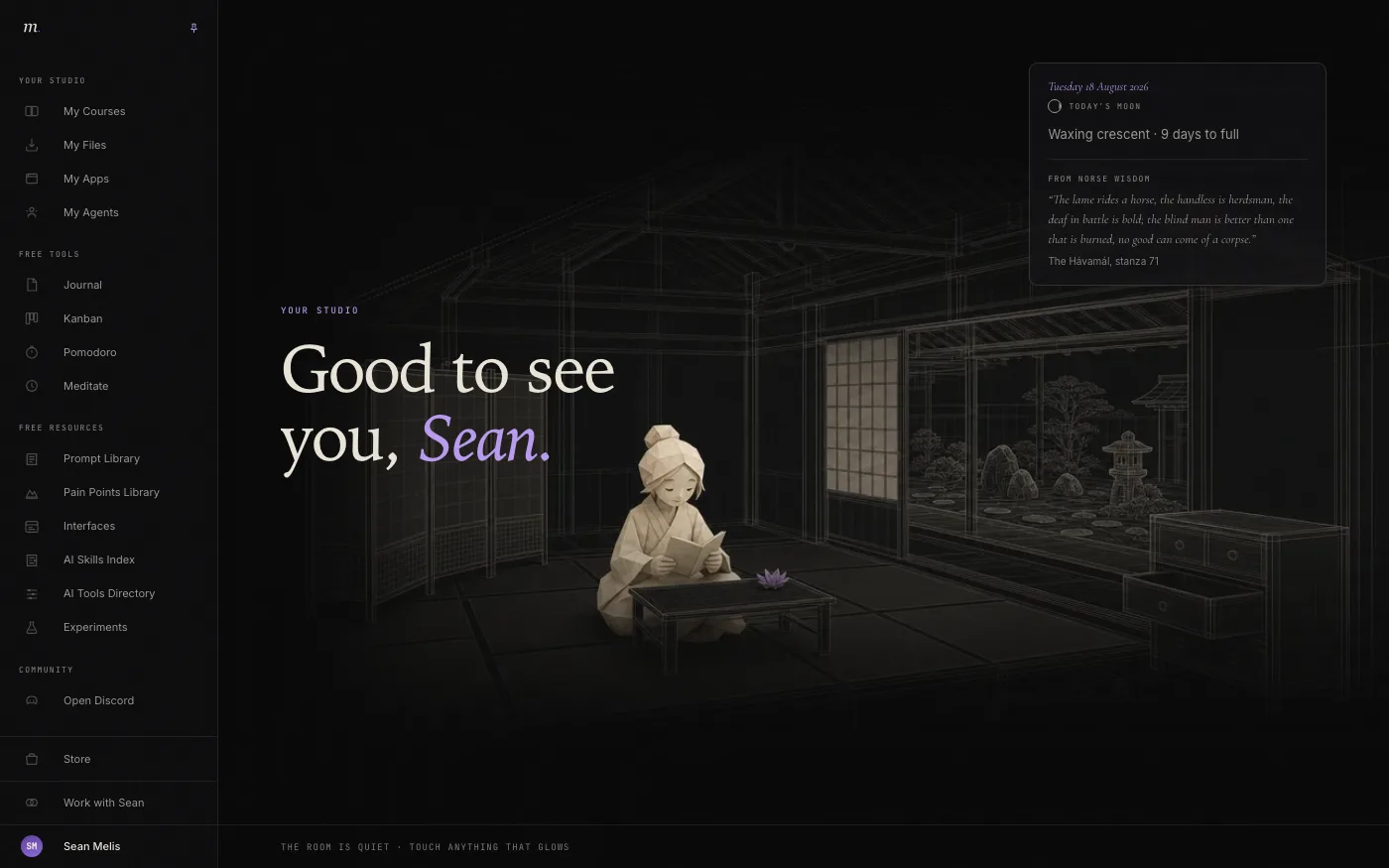
A look inside the StudioStudio preview
Your Studio
The Studio open on a desktop, showing the room and its side rail.
The same Studio on a phone.
A look inside the StudioWider on a desktop
Inside the Studio

Join once. Get all of this free.

The shop is where you find things. Your Studio is where they live. Anything you buy lands there too, everything runs in your browser, and your work stays private.

  • 365 promptsPrompt Library
  • 50 pain pointsProblems worth solving
  • 50 AI skillsSkills Index
  • 50 AI toolsTools Directory
  • ExperimentsBrowser-only tools
  • Private journalThink things through
  • Simple KanbanTo Do, Doing, Done
  • Focus timerPomodoro
  • Meditation timerA quiet pause
  • Interface galleryUseful patterns
No card required
Loading available times…
Custom work · By application

What do you want to build?

Tell me what you want built. I read every one, and reply if it’s a fit.

Aetherboard

One infinite whiteboard that lives on your Mac.

Try Aetherboard ↗ $99$49 onceFounding Owner

$99 after the first 100. Yours permanently, with 12 months of updates.

Mac, offline. You get the files and readable source.

Founding price$49 once
OwnershipFiles + readable source
Works onMac · offline
Standard price$99 after 100
The Aetherboard canvas: handwritten headings, sticky notes, pinned pictures and the tool bar along the bottom $99$49 onceFounding Owner
A calm paper-crafted workspace inside Aetherboard

Stop renting your thoughts. Own the board.

Try the real canvas in your browser. The first 100 owners pay $49 once, keep the Mac app permanently and receive 12 months of updates. The standard price is $99.

Pages, products and essays↑↓ move↵ openesc close