How to find a gap in the market before you build anything
Blue Ocean Strategy is a framework for finding markets with no competition instead of fighting for share in crowded ones. What melis.ai adds is how to use it with AI to do the research before you commit.
Drafted by an AI agent from the transcripts of AI Magic 2033, and checked line by line against what was actually said. The ideas, the examples and the working are Sean's. The first draft is not.
Most people look for gaps in the market by looking at what already exists. They find a product they like, assume there must be demand, and try to build a slightly better version. They enter a crowded category, fight on price or features, and discover that the customers they needed were already loyal to someone else.
Blue Ocean Strategy describes a different approach. Instead of competing for existing demand, you look for demand that has no product attached to it yet — people with a problem, and nothing serving them well. You build there. The competition comes later, once you have already established what the category is.
What red ocean and blue ocean actually mean
The framework comes from a book by W. Chan Kim and Renée Mauborgne. The core idea is simple: most industries are red oceans — existing markets where competitors are already fighting, the water is red with competition, and the only way to win is to take share from someone else. Margins shrink over time. Differentiation becomes marginal.
A blue ocean is a market you create rather than enter. No established competitors. No pre-existing customer expectations to fight against. You are not persuading someone to switch from a competitor's product. You are introducing them to a solution to a problem they currently solve badly, or do not solve at all.
The distinction is not about being first in time — it is about occupying genuinely different territory.
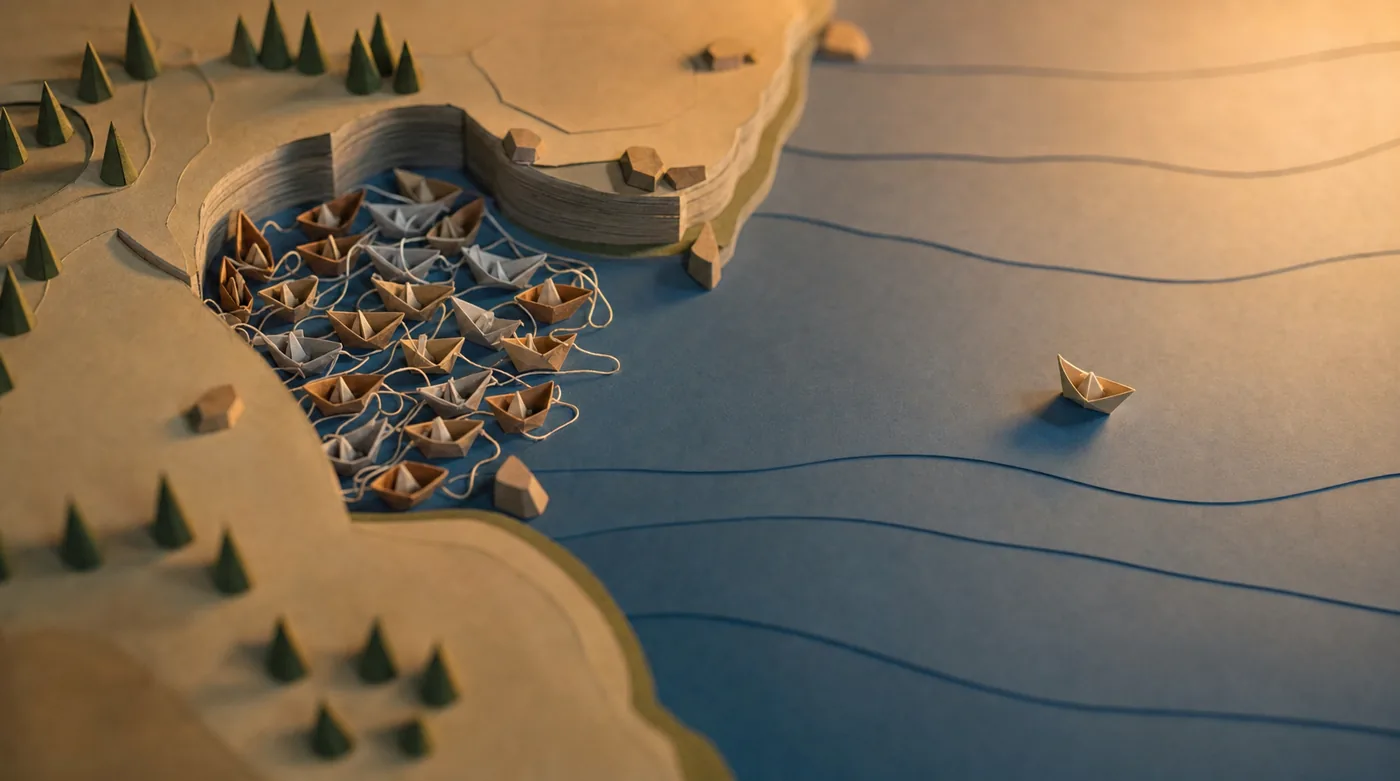
Lots of fish, zero hooks
There's vast empty ocean with lots of fish and lots of customers because they've never seen a product like this before. So you're operating in an area with lots of fish with zero hooks, zero competing hooks.
— Chapter 4.5 · 1:46
That image is the right one. The customers exist — people with the problem are out there. But nobody has yet built something for them that fits. You are not entering a market and hoping to claim a piece. You are building the market, because the demand is unmet.
The difference matters practically. Competing in a red ocean means your marketing is essentially a comparison: why your product is better than the alternative someone already knows. Building a blue ocean means your marketing is an introduction: here is a problem you have, here is what that problem costs you, here is what solving it looks like. A harder pitch in some ways, but one you own entirely if you get there first.
The phrase is powerful in a prompt
One thing worth knowing if you are using AI to do market research: the phrase "blue ocean" is a recognised signal that the AI understands. Drop it into a research brief and the AI immediately configures its approach to look for gaps rather than comparisons.
"Give me a blue ocean version of this idea" produces very different output than "help me improve this idea." The first asks the AI to find territory no one is occupying. The second asks it to iterate on something that already exists. Both have their uses. When you are at the ideation stage, looking for somewhere genuinely uncrowded to build, the blue ocean framing does a lot of work in a short sentence.
What blue ocean looks like in practice
The chapter applies this to a specific case: a business combining children's pyjamas and books. The initial hypothesis was that no one had done this. AI-assisted market research finds otherwise — a company called Dreamly Me already pairs character pyjamas with original storybooks.
That is not a dead end. It is exactly what the research is for.
The AI's analysis of what Dreamly Me actually does reveals where the gap still is. The existing competitors sell matching products — pyjamas and a book from the same character set. What they have not built is a relationship that develops over time: one character who accompanies a child across multiple reading milestones, from a first board book to early chapter books, with the pyjamas marking each stage as a reading uniform rather than just merchandise.
That is a different product. It is not competing with Dreamly Me on the same ground — it is building a different kind of thing in adjacent territory that the existing competitors have not occupied.
Blue ocean is not a better product — it is a different lane
This distinction is easy to miss. Blue ocean thinking does not mean your product has to be technically superior. It means you are not fighting for the same customers in the same way.
The revised concept in the chapter is not "better children's pyjamas" or "more educational books." It is a wearable reading journey — a product whose core value is the ritual and the long arc, the way one character grows alongside the child, the fact that parents are building something with their child over years rather than buying a seasonal product. That is a different category even though it uses the same component parts.
The question to ask at the ideation stage is not "is my version better than what already exists?" It is "am I operating in the same lane, or am I genuinely doing something different?" The research helps you answer it honestly before you spend time or money building.
Doing the research with AI
The process the chapter shows involves asking AI to scan the existing market, find what is already there, and then identify the specific gap between what exists and what the customer actually needs. The AI can pull in information about when competitors launched, what their product lines include, what their marketing emphasises, and where the reviews suggest customers feel underserved.
That research used to take hours of manual work — reading competitor websites, searching review platforms, scanning industry reports. Done with an AI agent, it runs in minutes. The output is a landscape map: here is who is playing, here is what they are selling, here is what the current offering does not do.
What the AI cannot tell you is whether your blue ocean idea will work. That requires testing — specifically, taking a visual concept to five real people and watching how they respond. The market research tells you whether the gap exists. The human conversations tell you whether filling it is something people would actually pay for.
What usually goes wrong
The most common error is calling something a blue ocean when it is not. The idea feels original to the person who thought of it. The market research either is not done, or is done superficially, or confirms the hypothesis without challenging it. The product launches into a category that already has three strong incumbents, and the founder is surprised.
The research phase described in the chapter does not let you get away with this. You ask the AI to find what is already in the market, not to confirm that your idea is original. The distinction is subtle but important. Confirmation bias in market research is real, and the way to counter it is to start from "show me what exists" rather than "prove that nothing exists."
The second error is finding a genuine blue ocean and then building the wrong product to fill it. The gap you identified might be real — parents want a long-arc reading relationship with their child — but the product you build might not actually solve it. That is where the testing phase begins, and why the research and the validation are two separate steps.
Drawn from chapter 4.5 of AI Magic 2033.